
Why Buying in the Desert Is Different Than Buying Anywhere Else
Why Buying in the Desert Is Different Than Buying Anywhere Else
People often assume buying a home in the desert is simply a sunnier version of buying elsewhere.
More palm trees.
More golf.
More sunshine.
But after years of touring homes, walking communities, and helping buyers relocate from places like Los Angeles, Seattle, Chicago, and Canada, I’ve learned the desert operates a little differently.
And many of the things that matter most here aren’t obvious during a quick weekend visit.
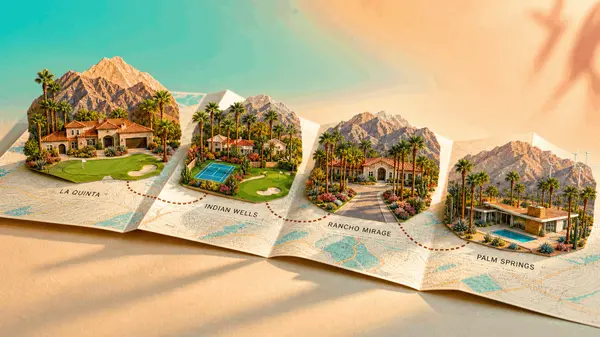
The desert has its own rhythms, quirks, and lifestyle dynamics — especially across communities in Palm Springs, Rancho Mirage, Indian Wells, Palm Desert, and La Quinta.
The details matter.
Gated Communities Change the Buying Process
One of the first surprises for many out-of-town buyers is how much of desert living exists behind gates.
Unlike many cities where buyers casually explore neighborhoods through open houses, much of the desert market requires:
- scheduled access
- private showings
- guest registration
- agent coordination
Some communities are intentionally quiet and private. Others are socially active and highly connected.
That means buying here often involves more planning, more curation, and more guidance than buyers initially expect.
Especially during season.
The Desert Is More Lifestyle-Driven Than Many Markets
In many cities, buyers focus primarily on commute times, school districts, or square footage.
Here, buyers are often choosing between entirely different ways of living.
Some buyers want:
- active club environments
- golf and social calendars
- restaurants and community energy
Others want:
- quiet retreat spaces
- mountain views
- privacy
- slower rhythms
- lock-and-leave simplicity
Two homes with similar prices and layouts can create completely different emotional experiences depending on:
- orientation
- neighborhood culture
- HOA structure
- social activity
- surrounding architecture
- seasonal occupancy patterns
This is one reason the desert can feel surprisingly nuanced.
Microclimates Are Real
This is one of the most underestimated parts of desert buying.
People often think:
“Hot is hot.”
But conditions can vary dramatically depending on:
- wind exposure
- elevation
- mountain positioning
- landscaping
- lot orientation
- community location
Some patios become unusable at certain times of day.
Others stay protected and comfortable far longer than expected.
Even sunlight behaves differently here.
A west-facing wall in July tells a very different story than the same wall in January.
Experienced desert buyers learn quickly that orientation is not a small detail — it’s part of daily livability.
Lease Land Creates Confusion
Another uniquely desert conversation involves lease land.
Some buyers discover a beautiful home priced significantly below surrounding properties and wonder:
“Why is this one so much cheaper?”
Often, the answer involves land ownership structure.
Certain desert communities sit on tribal-leased land rather than fee simple ownership.
This does not automatically make a property “bad” or undesirable. Some buyers are perfectly comfortable with lease land and enjoy wonderful homes and communities there.
But it does create important considerations involving:
- financing
- appreciation
- resale dynamics
- lease expiration timelines
- long-term planning
Understanding those distinctions matters before falling in love with a property based solely on price.
The Desert Is Seasonal — Emotionally and Socially
The desert changes throughout the year.
Winter and spring bring energy, events, snowbirds, golf tournaments, dinner parties, and packed patios.
Summer becomes quieter, slower, and more introspective.
Some buyers love the seasonal contrast.
Others prefer communities that maintain stronger year-round activity.
That’s why I often encourage buyers to think beyond:
“How does this home feel today?”
And instead ask:
“How will this lifestyle feel across an entire year?”
The Best Desert Purchases Usually Align With Lifestyle First
The buyers who seem happiest in the long term are rarely the ones chasing the “perfect deal.”
They’re usually the buyers who correctly matched:
- their rhythms
- their priorities
- their social preferences
- their energy level
- their desired pace of life to the right home and community.
Because buying in the desert is rarely just about real estate.
It’s about how someone wants life to feel.
And that’s what makes this market so different from almost anywhere else.
Recent Posts